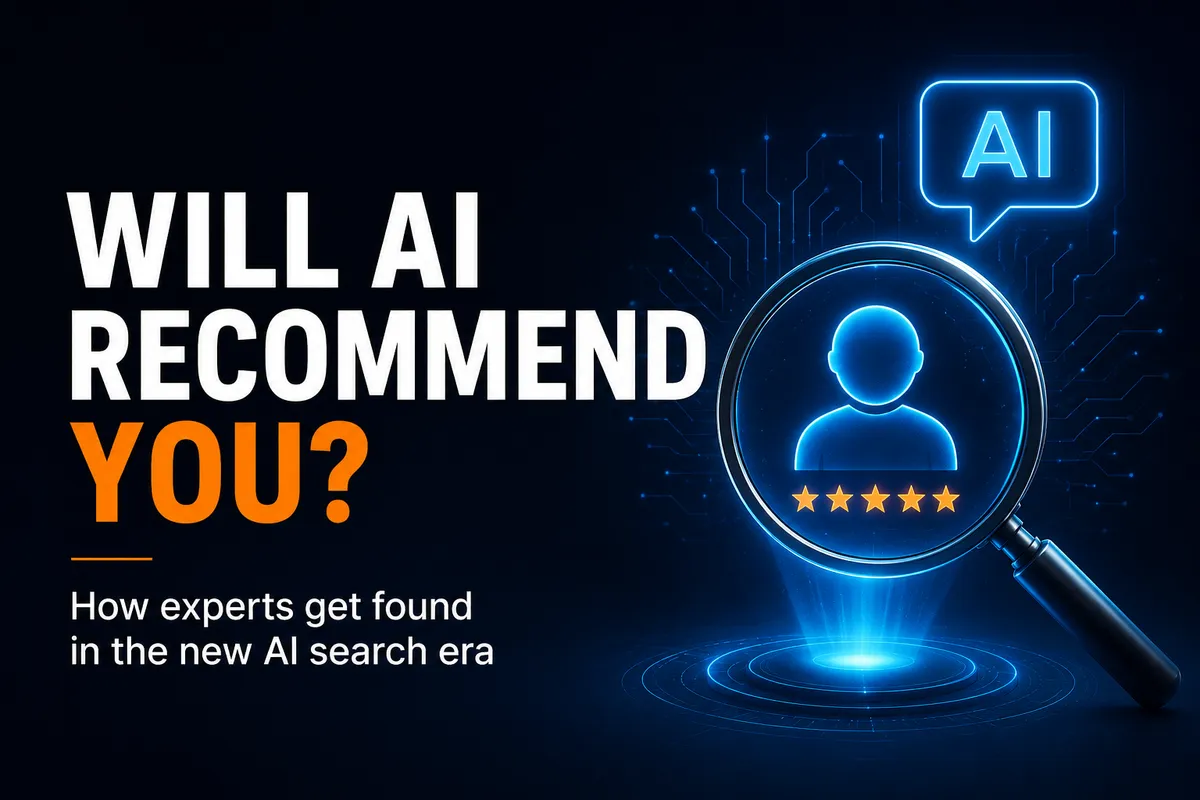
Will AI Recommend You? How Experts Get Found in AI Search.

Quick Answer
AI is changing how buyers discover experts, consultants and professional-service providers. Instead of moving neatly from Google to a website to a sales call, buyers can now ask ChatGPT, Gemini, Perplexity and Google AI tools for recommendations, comparisons and summaries before they ever visit your site.
For experienced professionals, the new challenge is not simply visibility. It is findability: can AI accurately understand who you are, what you do, who you help and when you should be recommended?
For years, online marketing followed a pretty predictable playbook. Build the website. Get found on Google. Grow the email list. Post on LinkedIn. Run some ads. Say “funnel” every few minutes so everyone knows you’re taking this seriously.
It wasn’t perfect, but at least we understood the rules.
Those rules are changing.
Buyers now have another option. Instead of clicking through ten search results, they can ask an AI tool a direct question:
Who are the best consultants for this?
Who specializes in that?
Who can help me solve this particular problem?
And increasingly, AI answers before the buyer ever lands on your homepage.
That’s a very different marketing environment.
What Is the Difference Between Visibility and Findability?
Visibility asks:
Can people see you?
Findability asks:
Can AI and search systems understand when to surface you?
Those are not the same thing.
You can have a big LinkedIn following, a decent website, years of podcast appearances and enough content to fill a storage unit, and still be poorly understood by AI.
That happens when the evidence around your expertise is vague, inconsistent or outdated.
Your website says one thing. LinkedIn says another. Your YouTube channel reflects your old business. Your About page calls you a “speaker, strategist, consultant and thought leader.”
Congratulations. You have given AI approximately the same clarity as a fog machine.
Why Does This Matter Commercially?
Because buyers are increasingly using AI before they ever talk to you.
Google now explicitly treats AI Overviews and AI Mode as part of Search, and its current guidance says the same core SEO rules still matter: your pages need to be indexable, useful, reliable and eligible to appear in normal Search in order to be surfaced in AI features.
OpenAI also says any public website can potentially appear in ChatGPT search, provided its crawler is not blocked.
That means your public content is increasingly becoming raw material for machine-assisted discovery.
The question is whether that material tells a coherent story.
Why Experienced Experts Have an Advantage
This is where I’m actually optimistic.
AI has made polished content cheap.
A person with thirty years of experience and a person with thirty minutes of prompting can now publish articles that look surprisingly similar.
Only one of them may know what the hell they’re talking about.
That gives experienced professionals something valuable:
real client experience
judgment
stories
pattern recognition
mistakes survived
original opinions
lessons learned over time
The problem is that much of that expertise is invisible.
It’s sitting in old webinars, Zoom calls, books, talks, client conversations and the back of your brain.
If you want AI and buyers to understand it, you need to make that expertise public and legible.
What Should Experts Do First?
Start with one question:
What do I want my name associated with?
Then write one clean sentence.
For example:
Lou Bortone helps established experts use AI and video to become more visible, trusted and chosen.
Now compare that sentence with your:
homepage
LinkedIn profile
YouTube channel
About page
Substack
speaker bio
podcast bios
Do they reinforce the same basic story?
They don’t need to use identical wording.
They do need to make the same association.
What Is the New Marketing Job?
The job is not to become a deranged content hamster publishing seven times before breakfast.
It is to create a clear body of public evidence around your expertise.
That means:
clear positioning
useful articles
visible proof
original point of view
video
consistent author information
content that answers real buyer questions
You are not trying to “hack ChatGPT.”
You are trying to make the correct interpretation of your expertise easier than the wrong one.
That’s findability.
Lou’s Take
I’ve been through enough marketing revolutions to know that waiting for things to “go back to normal” is not a strategy.
AI isn’t replacing every marketing channel.
It is becoming another layer between the buyer and the expert.
My goal is simple: leave enough clear, credible evidence online that when AI or a buyer starts looking for someone with my expertise, the decision becomes pretty damn easy.