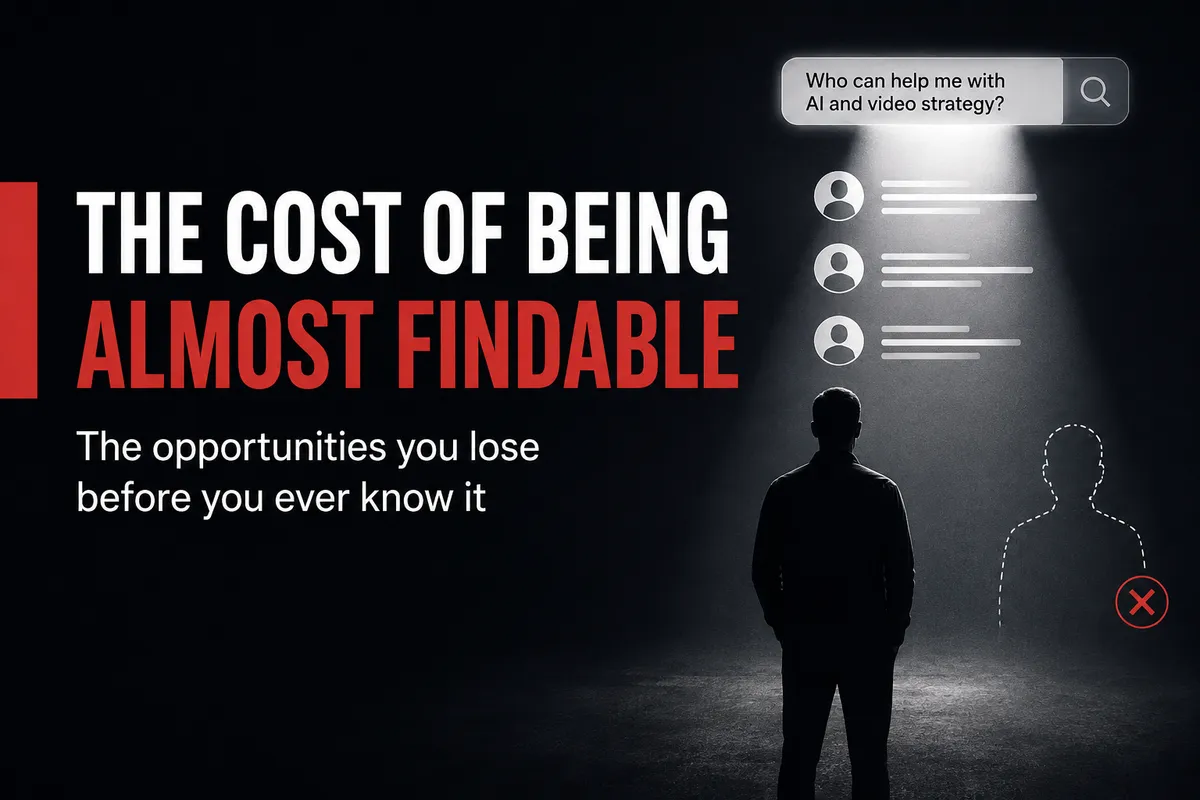
THE COST OF BEING ALMOST FINDABLE
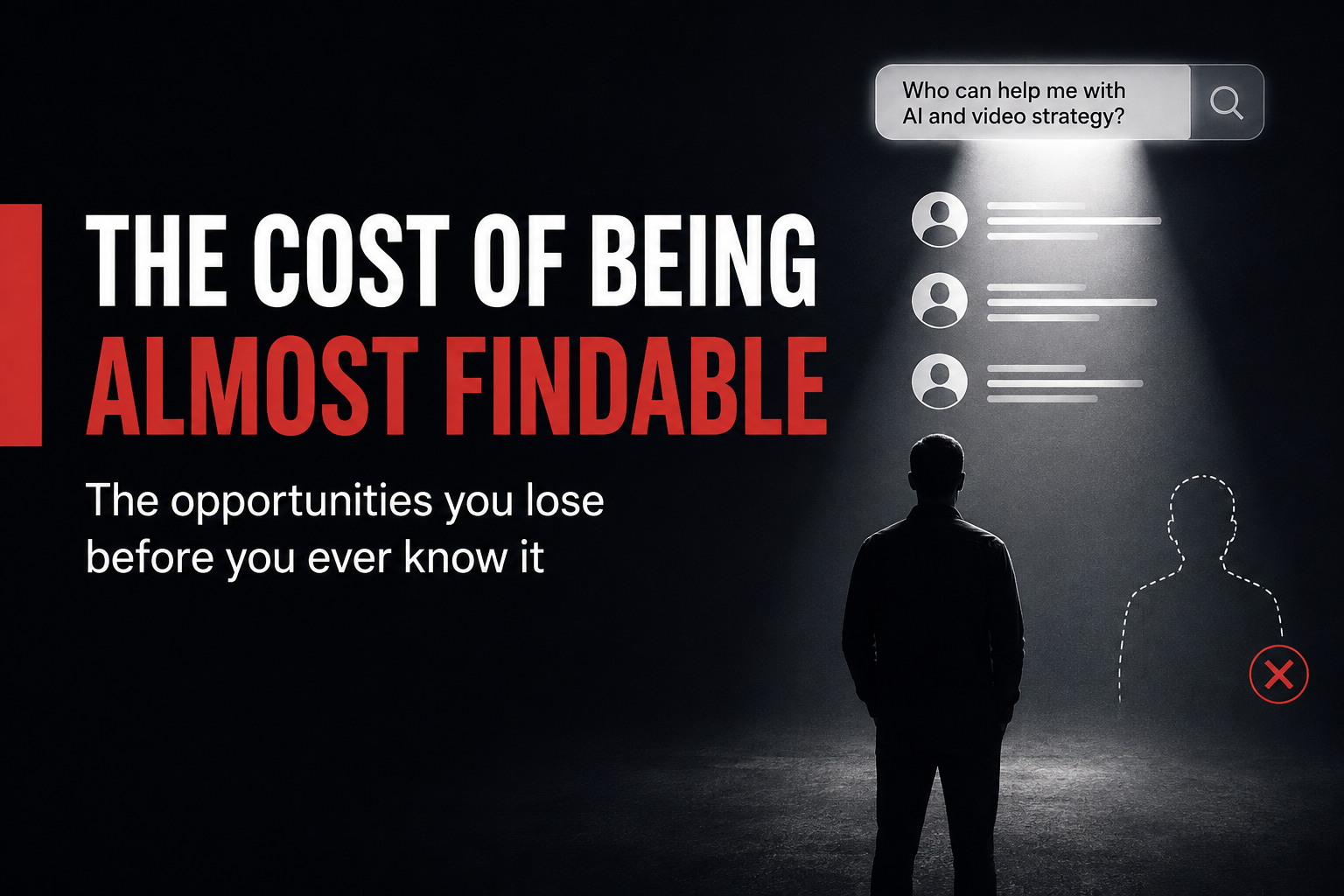
THE COST OF BEING ALMOST FINDABLE
Quick Answer
Being almost findable means having a substantial online presence without being clearly associated with the exact problems buyers are trying to solve. The commercial cost is difficult to measure because the buyer may never contact you. They simply discover someone else first.
Here’s the marketing metric I’d most like to see:
Revenue lost because somebody who needed exactly what I do never discovered me.
Good luck finding that in Google Analytics.
Somebody needed your expertise last Tuesday.
They had budget.
They were serious.
They asked colleagues.
They searched.
They asked AI.
They created a shortlist.
You weren’t on it.
You never knew.
That is the cost of being almost findable.
Why Is This Hard to Measure?
Because most losses leave evidence.
You lose a proposal.
You know.
A prospect says no.
You know.
A client leaves.
You definitely know.
But if you never entered the consideration set, there is nothing to record.
No email.
No call.
No lost-opportunity notification.
Nothing.
Why Does AI Make This More Important?
Because more evaluation can now happen before a buyer visits your site.
Google says its AI features rely on Search systems to retrieve relevant pages from the web, and pages need to be crawlable and indexable in order to appear as supporting sources.
ChatGPT search follows the same basic principle: if your public content is blocked from OAI-SearchBot, it may not be available for summaries and citations.
That means the buyer’s early shortlist may be influenced by material they encounter before ever landing on your homepage.
Visible Is Not the Same as Findable
You can search your own name and appear everywhere.
That proves one thing:
People can find you after they already know your name.
The more interesting question is:
Can they find you before they know who you are?
If someone asks:
“Who helps experienced consultants use AI and video to improve visibility and authority?”
Do you appear?
Does your content clearly connect your name with that problem?
Is there enough evidence to support the association?
That is commercially meaningful.
Why “Almost Findable” Can Be Dangerous
Because it creates false confidence.
You have followers.
Your site gets traffic.
Your Google results look fine.
You’ve been on podcasts.
Your LinkedIn profile is active.
Everything feels healthy.
But none of those things answers:
Am I showing up when a buyer is actively looking for the exact problem I solve?
That is a different metric.
How Do You Run a Buyer-Intent Audit?
Write down five questions someone might ask when they are close to needing your help.
Not broad educational questions.
Commercial questions.
Then search them in:
Google
ChatGPT
Gemini
Perplexity
Look at:
who appears
which pages get cited
what language repeats
what types of evidence show up
Then compare that with your own content.
Do you clearly answer the questions?
Do you demonstrate expertise?
Is your positioning consistent?
Is your proof public?
That tells you what to work on.
What Should the Goal Be?
Not Internet fame.
Not vanity metrics.
Not ranking first for your own name.
The goal is simpler:
Be present when the right buyer is looking for the problem you solve.
That’s why my shorthand remains:
Found. Trusted. Chosen.
Findability gets you into the conversation.
Proof and video build confidence.
A clear offer gives the buyer somewhere to go.
You need all three.
Lou’s Take
I’ve spent most of my career around marketing metrics.
Traffic.
Email opens.
Views.
Subscribers.
Reach.
Engagement.
They all have their place.
But the question I care about now is simpler:
Am I present when somebody has the problem I solve?
Because being the best-kept secret in your industry sounds charming.
Until you check the revenue.
Lou Bortone is an AI Video Marketing Strategist, Certified AI Consultant, author and speaker who helps established experts, consultants and business owners use AI and video to become more visible, trusted and chosen.
Before moving into digital marketing, Lou spent more than 20 years in television and entertainment marketing. Today, he combines that experience with practical AI strategy to help experienced professionals strengthen their authority, improve AI findability and stay commercially relevant as buyer discovery changes.
Refuse to Be Irrelevant. Become Impossible to Ignore.